













Electric vehicle range anxiety has long been the primary hurdle for large-capacity family haulers and utility vehicles. While early entries like Volkswagen’s ID. Buzz captured hearts with nostalgic styling, they often fell short on long-distance endurance, managing around 200 real-world miles per charge. However, the paradigm is shifting rapidly, and once again, the disruption is coming out of China.
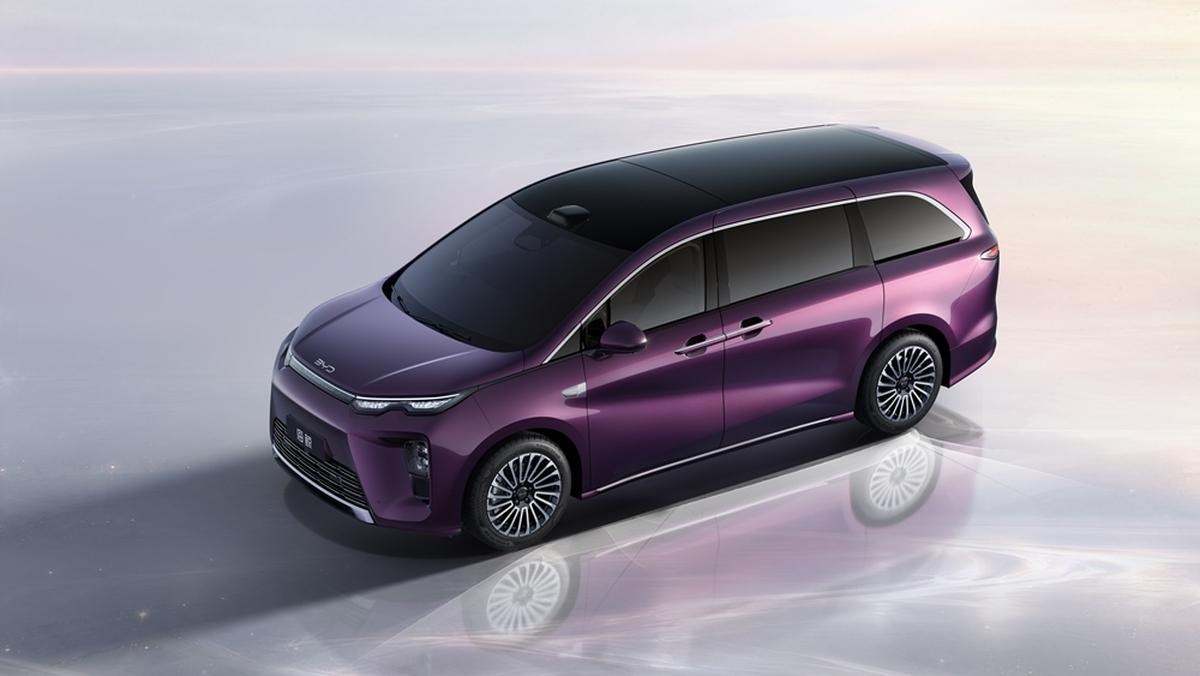
Automotive giant BYD has just revealed its latest flagship electric people-mover—a striking purple behemoth designed to shatter current EV range expectations. Officially dubbed the BYD Whale, this massive multi-purpose vehicle (MPV) promises an eye-watering estimated range of 559 miles (900 kilometers) on a single charge, setting a terrifyingly high benchmark for legacy automakers across the globe.
Engineering a Colossus: Size and Battery Capacity
Living up to its aquatic moniker, the BYD Whale is gargantuan in every sense of the word. A quick look at the dimensions reveals a vehicle engineered to dwarf familiar Western family vans like the Honda Odyssey, Chrysler Pacifica, and Toyota Sienna.
- Length: 17.3 feet (5,270 mm)
- Width: 6.5 feet (1,996 mm)
- Height: 6 feet (1,815 mm)
- Wheelbase: 123 inches (3,130 mm)
To achieve the staggering 559-mile range, the Whale relies on massive battery architecture integrated into its expansive floorpan. While hyper-extended ranges traditionally rely on extended-range electric vehicle (EREV) setups or enormous pure-BEV battery packs, BYD’s proprietary Blade Battery technology plays a crucial role in maximizing energy density without compromising interior passenger and cargo volume.
The Evolution of the Electric People-Mover
For years, the minivan market has been an afterthought in the electric transition, largely due to the sheer physics of moving a heavy, boxy vehicle at highway speeds. Early attempts struggled with aerodynamic drag and excessive weight, leading to disappointing efficiency metrics.
The BYD Whale addresses these challenges through a combination of ultra-efficient powertrain management, advanced thermal controls, and sleek, aerodynamic styling that disguises its massive footprint. By offering a true long-range solution, BYD is targeting not just large families, but also executive transport services and commercial fleets that require all-day reliability without frequent charging stops.
Global Industry Impact
BYD’s relentless cadence of technological rollouts continues to put immense pressure on Western and Japanese automotive incumbents. As Chinese manufacturers master the trifecta of aggressive pricing, lightning-fast charging speeds, and class-leading battery range, global competitors are forced to rethink their electrification roadmaps.
If vehicles like the BYD Whale successfully transition from domestic Chinese availability to global export markets, international manufacturers will find it increasingly difficult to justify selling lower-range, higher-priced alternatives to consumers who demand true utility.
Concluding Thoughts
The electric vehicle revolution is maturing past the hatchback and crossover phases, moving aggressively into heavy-duty utility and high-capacity transport. With the introduction of the BYD Whale and its unbelievable 559-mile range capability, the excuse that “EVs can’t handle long family road trips” is officially dead. As competition heats up, the ultimate winner will be the consumer—provided these technological marvels find their way to international driveways.